Westmont's Bridge to San Francisco
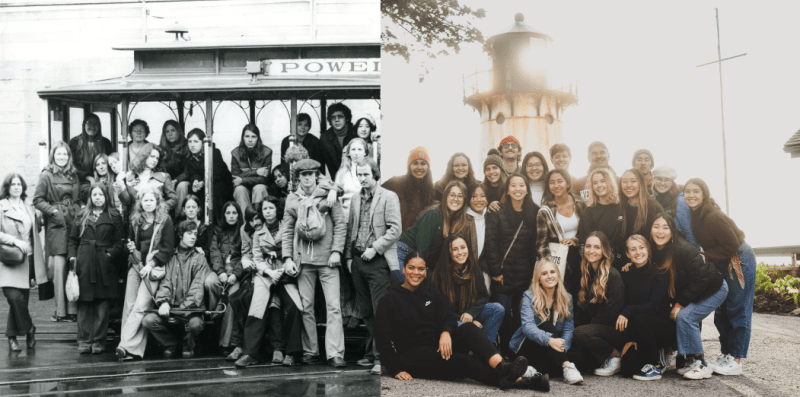
Two sociology professors sought a dynamic way to explore urban problems with their Westmont students in the late 1960s. For three years, Brendan Furnish and Ron Enroth dedicated 10 days of their Christmas break to taking 20 students to San Francisco. They toured the inner city and worked with local social service agencies to encounter and learn about the challenges facing urban areas and their marginalized residents. Furnish, who came from the Bay Area, had studied urban issues, and Enroth wanted to introduce his students to the sociological practice of participatory observation.
Enroth later recalled that they asked each other, “What if we could somehow come up with an Urban Semester, where these students would experience some of these things and have employment or placement in internships?” The San Francisco Urban Internship Program (now Westmont in San Francisco, WSF) began with a pilot program in spring 1971, and the semester launched officially in fall 1972. Working closely with Furnish and Enroth, Robin Wainwright ’64 and Ron Fagan ’70 directed the inaugural program, based at Lone Mountain College, with 31 Westmont students and two Wheaton students.
While the semester grew out of the sociology department, it soon expanded to include students from all majors. In November 1972, Wainwright wrote a letter explaining the new initiative after a letter to the editor in the Horizon questioned its validity at a liberal arts college. “The urban environment serves as the laboratory for some foundational inquiry into a potentially wide range of subjects and problems about which we may already possess some theoretical knowledge,” Wainwright wrote. “The setting thus provides the opportunity to pursue further knowledge in a particular field of study through the use of new methods and resources. Hopefully, it also provides the opportunity to make new personal discoveries . . . We see the Urban Internship Program as being in full keeping with the best intentions of the liberal arts curriculum at Westmont. We see it as both an extension of the learning process and a stimulation to that process.”
After a visit to San Francisco, psychology professor Craig Ellison submitted a report about the fledgling semester in September 1972. He noted that students traveled to sites to select their internships and attended sessions on the city’s history and the church’s historical involvement.
Before taking field trips to mental health and aging agencies, they watched films on aging and mental health in the inner-city. In the coming weeks, they’d hear talks about welfare rights and Haight-Ashbury. Ellison mentioned the goals of creating an interdisciplinary program and recruiting students from other Christian colleges.
“There is a high level of excitement about learning among the students,” he said. “The program staff has worked creatively for long hours. There seems to be a general sense of togetherness and anticipation. I was excited by what I saw and heard.”