WELCOME TO THE
Westmont Observatory

Observatory Opens for Partial Eclipse
The Westmont Observatory opens to the public for a near total lunar eclipse on Thursday, Aug. 27, beginning at 8:30 p.m. with the max eclipse set to happen at 9:12 p.m. Members of the Santa Barbara Astronomical Unit will also attend with telescopes to share.

Jennifer Gee, assistant professor of physics and director of the observatory, says the eclipse will already be underway when the moon rises.
“This almost total lunar eclipse scores a 96.2% coverage which is a solid A in my gradebook,” she says, “and it’s predicted to still turn the moon red.”
The last total lunar eclipse in the region was March 3, 2026.
The public viewings are a staple community resource, held on the third Friday of every month. The events are completely free and last for several hours, offering an accessible, educational evening for space enthusiasts of all ages.
Free parking is available near the Westmont Observatory, which is between the baseball field and the track and field/soccer complex. To enter Westmont's campus, please use the Main Entrance off of La Paz Road. The lower entrance off of Cold Springs Road is closed to visitors after 7 p.m. Here is a map with directions to get to the observatory.
KECK TELESCOPE
The Keck Telescope, a computer-controlled 24-inch F/8 Cassegrain reflector with Ritchey-Chretien optics (the same configuration used on the Hubble Space Telescope), has served as a versatile instrument for Westmont faculty and students for over a decade and remains one of the most powerful telescopes on the California Central Coast. Not only has the device been used for a variety of research projects and coursework, but it has also been a source of awe and inspiration for the greater Santa Barbara community.
The Westmont Observatory also serves as one of the free, public observing sites for the Santa Barbara Astronomical Unit (SBAU) every third Friday of the month. In particular, the Keck Telescope has provided clearer and more dramatic demonstrations of the splendor of God’s creation to members of the broader Santa Barbara community, including young children and students in local schools.
“The observatory remains a signature component of the Westmont campus and a favorite among our current students and returning alumni,” says Professor Bob Haring-Kaye from the Department of Physics and Engineering. “We are excited to see how this facility will continue to be used to provide outstanding educational experiences, including meaningful research experiences, to our students and point to the artistic grandeur of the Creator.”
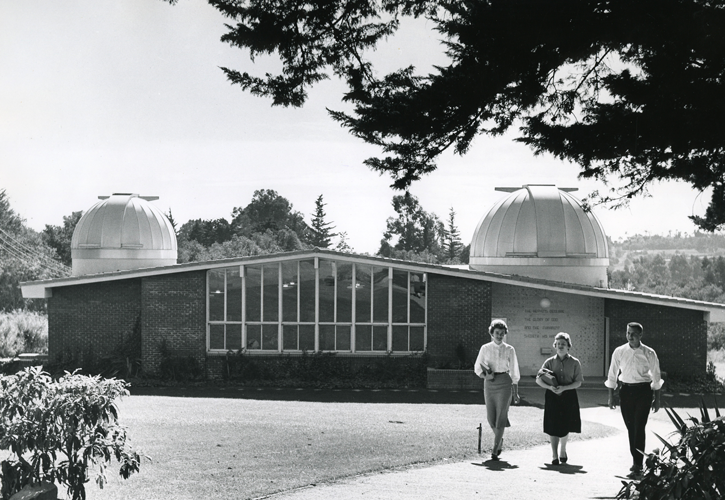
History
The original Westmont College Observatory was dedicated on June 1, 1957. (It has since been replaced by a new observatory in 2010.) The main dome featured a 16.5-inch reflector which was made and donated by George Carroll. The scope was equipped for spectroscopic and micrometric work, whose introduction originally made national news.
More recently, the original telescope caught the limelight as a group of amateur astronomers from the Santa Barbara Astronomy group observed the rotation of Mars with a CCD camera (Astronomy Magazine, Feb. 1989, p. 92.) These were some of the very first CCD images of Mars taken by amateurs.


Contact
Assistant Professor of Physics | 805-565-6094
Professor of Physics and Chair of Physics and Engineering | rharingkaye@westmont.edu, (805) 565-6835
Manager of Media Relations | scraig@westmont.edu, (805) 565-6051
Telescope Viewing Hotline | (805) 565-6272