Seeking Healing and Wholeness in Christ
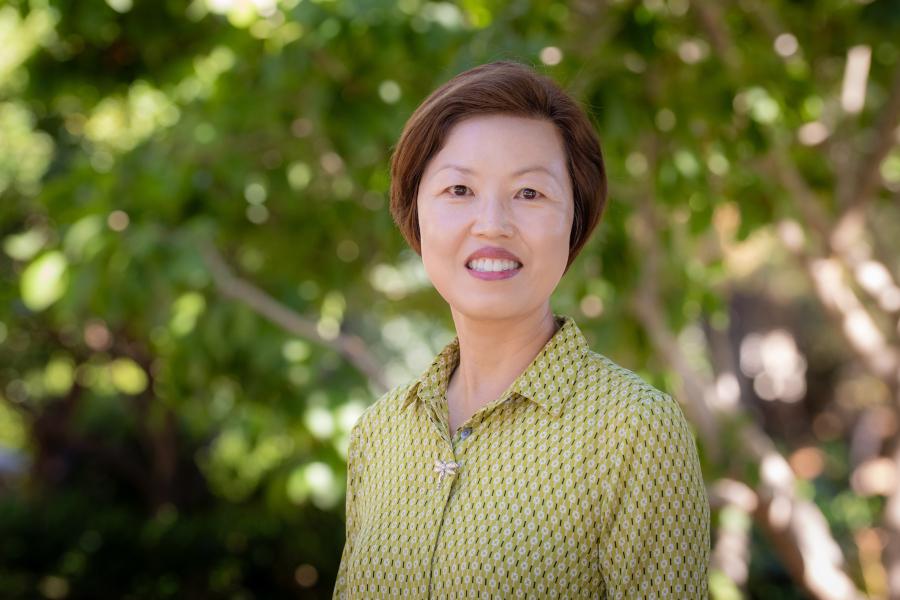
Students in Helen Rhee’s Embodiment and Suffering class received an unusual assignment this fall. The religious studies professor and church historian directed them to leave Adams 217, where they meet, go to the library, pretend to return a book and then head to their supposed next class in the Global Leadership Center — only using paths accessible to someone in a wheelchair. Anyone who knows the campus recognizes the potential difficulties awaiting these students.
Rhee wants able-bodied students to better understand the challenges of limited mobility. She knows all the routes around campus that avoid steps and stairs as she lives with chronic pain and illness. Some students reported frustration, and one gave up. “Now they see the physical campus in a different way,” she says. “I’ll repeat the exercise at the end of the semester to see if they’ve discovered the accessible pathways and the difficulty of navigating steep hills, uneven surfaces and steps.”
The interdisciplinary course, which explores both theological and practical issues, grew out of Rhee’s research for a book she published in 2022: “Illness, Pain and Healthcare in Early Christian Communities.” “I explore how early Christians engaged with Greco-Roman medicine and how they made sense of sickness, pain and care for the ill and suffering,” she says. “Early Christians contributed enormously to the founding and development of hospitals organized and run by bishops and monastic leaders. I’m interested in the theological meanings attributed to illness and pain, the religious status of those suffering afflictions, and the methods, systems and rituals Christian individuals, churches and monasteries devised to care for those who suffered.”
Rhee first offered the course on embodiment and suffering to nine students in 2019, approaching the topic from biblical, theological, historical, socio-cultural, philosophical, and psychological perspectives to recognize and reflect on their manifold dimensions and impacts.
“It was a deeply meaningful course for me to teach,” Rhee says. “I got good feedback from the students, who told me it was the most practical course they’d ever taken. We focused on more than just theoretical issues, discussing a practical theology for those who suffer or provide care for the suffering.”
Rhee planned to teach it again, but the pandemic caused a delay until this fall. Twenty students enrolled and represent a variety of majors, including religious studies, philosophy, English, biology, psychology, kinesiology and economics and business. “Such a diversity of perspectives makes it a rich experience for me,” Rhee says. Limiting the class size helps encourage discussion. With 14 students on a waiting list, she plans to teach the course again next fall.
“I’m encouraged that students take this heavy subject seriously and engage it in an authentic way, raising good questions,” Rhee says. “They first meet in small groups to promote communication, and students can volunteer to serve as facilitators. The whole class then engages topics together.”
Rhee began working on the book in 2016, and her research and discoveries motivated her to teach the class in 2019. During a spring semester sabbatical that year, she studied at Biola’s Center for Christian Thought, which had chosen suffering as a topic for the year. “I could relate to this topic and do further research for a chapter I was writing on pain,” Rhee says. “Fifteen Christian scholars worked together in this area, including ethicists and others outside of religious studies. We did a lot of listening and learning, each contributing to the discussion and submitting a research project at a concluding mini-conference.”
Given her own health challenges, Rhee asks, “How can we support people who go through embodied suffering? We all experience this one way or another or our close friends and relatives do as they navigate a new kind of normal. A theology of suffering matters for those who are ill as well as those who provide care.”
Rhee extends her thinking to explore discipleship for those with cognitive challenges. Her mother suffers from dementia and lives in a nursing home, so she’s especially interested in the question. “I want to offer a small platform to engage students on why these issues matter theologically for our Christian formation and why they matter practically,” she says. “How do we develop greater understanding and empathy for those who suffer, who bear the image of God. How do they live as Christians?”
In the class, she also discusses healing, a mainstay of Jesus’s ministry. She asks, “Should we always expect healing? How does God heal through medicine? What’s the relationship there? How do we recognize the limits of medicine?”
During her fall 2024 sabbatical, Rhee participated in a gathering of scholars, pastors, physicians and seminary students to engage the issues she discusses in her book and in class. Author J. Todd Billings, a theologian and founder of the Faith and Illness Initiative at Western Theological Seminary in Holland, Michigan, organized the event, which focused on chronic pain and Christian discipleship. He and Rhee put together a reading list and asked participants to consider how they could pray not only FOR people who suffer — but also WITH those who suffer. What does it mean for those living with pain to have hope (when their pain apparently has no end in sight)?
The group addressed many questions, including: What is it like to live with chronic pain with no end in sight? “Our conversations addressed what it means to lament, something Christian churches rarely focus on,” she says. “How do Christians make sense of cancer and incurable illnesses? How do they live with hope while lamenting and continuing to be committed disciples of Christ?” In developing a theology of suffering, Rhee includes illness, chronic pain, all kinds of disabilities and mental health challenges such as depression. “How do we hold on to faith through these experiences?” she asks. “We know that Jesus Christ suffered and died and understands our situation.” That knowledge helps her endure when people say unhelpful things to her.
In his book, “Rejoicing in Lament: Wrestling with Incurable Cancer and Life in Christ,” Billings shares his own diagnosis of incurable cancer at the age of 39 and his struggle to make sense of it as a believer. He considers this issue both theologically and practically. Rhee quotes one of his conclusions, “God doesn’t owe us anything, and we’re not entitled to a beautiful, healthy American lifestyle,” noting that Billings holds fast to his faith.
Rhee explores these issues for both her work and her pain, asking “As Christians and scholars, how do we walk beside those who live in pain, and what does it look like to deal with pain?” This matters to Rhee personally amidst her 37-year struggle with chronic pain and illness. Like (many) other Christians who undergo persistent (long-term) illness and/or pain, she had at times asked God, “Why me?” and had regarded her pain as God’s punishment for her hidden sins, as a result of her lack of faith, and/or the sign that God had forsaken her. Over the years, she says, “So many friends, church members and even my Westmont students have prayed for God’s miraculous healing for my pain.” However, she realized that God’s healing could not be the condition of her relationship with God. “God can certainly heal me, but an expectation of healing can’t dictate my relationship with God,” she says. “It’s hard and challenging, and I often feel exhausted. Much as I want release from my pain and restorative sleep when I don’t get it, I still live and experience God’s sufficient grace. My goal is to continue to do that and share it with others.”
She quotes one of her life verses, II Corinthians 12:7b-10 (NIV).
Therefore, in order to keep me from becoming conceited, I was given a thorn in my flesh, a messenger of Satan, to torment me. Three times I pleaded with the Lord to take it away from me. But he said to me, “My grace is sufficient for you, for my power is made perfect in weakness.” Therefore, I will boast all the more gladly about my weaknesses, so that Christ’s power may rest on me. That is why, for Christ’s sake, I delight in weaknesses, in insults, in hardships, in persecutions, in difficulties. For when I am weak, then I am strong.
“Paul asked God to remove this thorn but didn’t get what he wanted,” Rhee says. “God says that his grace is sufficient and (God’s) power is perfected in (human) weakness. As Paul notes, Jesus died in weakness and in pain (2 Corinthians 13:4). Paul certainly didn’t lack the faith for healing!”
Instead of asking why — Rhee wrestled a lot with this question when she was younger — she now seeks to be attuned to God’s grace every day and share that with others. “Constant questioning didn’t lead me anywhere in my formation,” she says.
“My course engages all these real desires and questions that affect our faith and life in Christ. I want students to understand that we can be completely honest in our lament to God in the midst of our pain and challenges,” she says. “If we can’t do that with God, who else can we turn to? We lament just like the psalmists, not ending with it but moving from lament to petition to praise and hope in God.”
According to Rhee, we can learn to flourish despite (even in the midst of) pain, illness and suffering. “We live in a fallen world, but we can still worship God and live a life that is flourishing in God’s eyes.” She believes flourishing occurs only in community. “I constantly experience God’s grace through the tangible love, care, prayers, help and encouragement from my family, friends, neighbors, colleagues, church family and students. They channel God’s grace, and I hope and pray to do the same.” She considers empathetic listening to be critical. “Listen to those who suffer rather than being quick with advice. Your embodied presence matters even if you don’t know what to say.”
At the beginning of the semester, Rhee asked students to fill out an initial questionnaire about their religious background, their experiences with people with disabilities, mental health challenges, illness and pain, their one question about the topic and their prayer requests. Some students shared their own experiences and those of their families.
Each class, students turn in critical reading notes about the current assignment, noting one or two points of observation, insights from the reading and their questions. “I’ve been blessed by their perceptive responses,” Rhee says. “These responses show how students process the texts and their thinking honestly and thoughtfully. I’m grateful students are willing to engage and voice their own thoughts constructively.”
“Embodied human sufferings are deeply personal to all of us and can never merely remain intellectual issues. That’s why the course explores constructive and practical ways to deal with sufferings (pedagogies of suffering) and to engage and empathize with people who suffer. Ultimately, we seek to understand what healing and wholeness in Christ looks like.
Helen Rhee graduated from UC Berkeley with a degree in history and earned a Master of Divinity and Doctor of Philosophy from Fuller Theological Seminary. She joined the Westmont religious studies faculty in 2004 after pastoring Hana Church in Buena Park, California. She serves as an ordained minister at Free Methodist Church Santa Barbara. She teaches all periods of church history, specializing in the second through the fifth centuries. Her books include: “Early Christian Literature: Christ and Culture in the Second and Third Centuries”; “Loving the Poor, Saving the Rich: Wealth, Poverty, and Early Christian Formation”: “Wealth and Poverty in Early Christianity” and “Illness, Pain, and Health Care in Early Christianity.”
Recommended Reading
“Rejoicing in Lament: Wrestling with Incurable Cancer and Life in Christ” by J. Todd Billings (Brazos Press, 2015)
“Blessed: A History of the American Prosperity Gospel” by Kate Bowler (Oxford University Press, 2018)
“Everything Happens for a Reason: And Other Lies I’ve Loved” by Kate Bowler (Random House Trade Paperbacks, 2019)
“Embodied Hope: A Theological Meditation on Pain and Suffering” by Kelly Kapic (IVP Academic, 2017)
“The Theology of Illness” by Jean-Claude Larchet (St. Vladimir’s Seminary Press, 2002)
“Wandering in Darkness: Narrative and the Problem of Suffering” by Eleonore Stump (Oxford University Press, 2010)
“Living Well and Dying Faithfully: Christian Practices for End-of-Life Care” by John Swinton (Wm. B. Eerdmans, 2009)
“Becoming Friends of Time: Disability, Timefullness, and Gentle Discipleship (Studies in Religion, Theology, and Disability)” by John Swinton (Baylor University Press, 2018)