A Continental Traveler
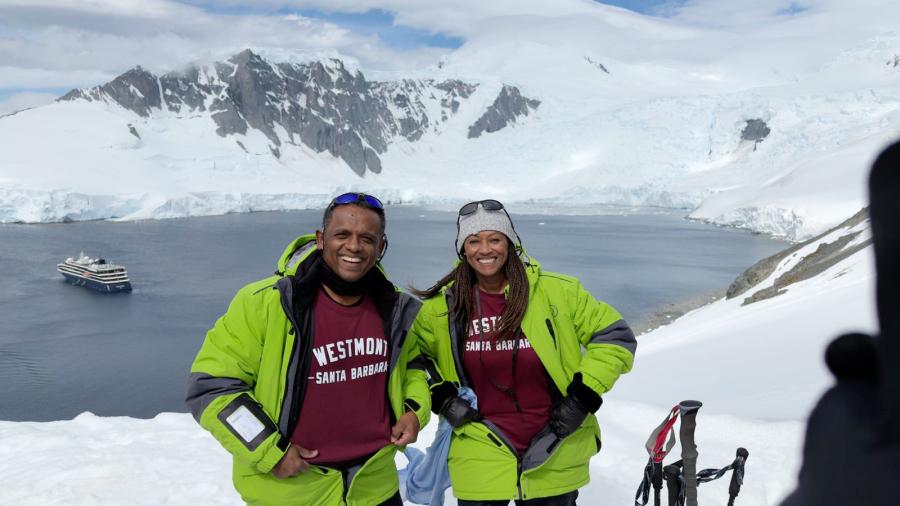
In December, Provost Kimberly Battle-Walters Denu added a new destination to her travel map: Antarctica. She has now visited seven continents — Asia, Africa, North America, South America, Antarctica, Europe and Australia — teaching, researching, ministering and traveling.
To dock in Antarctica, she braved the Drake Passage, where three oceans ferociously collide. “A patch behind the ear prevented seasickness,” she says. The expedition sailed from Argentina with passengers watching scientists at work and attending lectures on marine life, glaciers, ice shelves and climate change. “We hoped to share the gospel on the ship, and God opened doors to conversations about faith and Christianity,” she says. “We’re staying in touch with some of the people we met.”
“We hoped to share the gospel on the ship, and God opened doors to conversations about faith and Christianity.”
With her husband, Yohannes, Kim pursued adventures such as hiking on the peninsula, taking a polar plunge, getting stuck on the rocks while kayaking and visiting the research station. “It’s such a pristine, enchanting and untouched environment,” she says. “We focused on learning and observing, enjoying penguins and birds, including albatross. We’ve joined the small club of people who’ve landed in Antarctica.”
A sociologist with a doctorate from the University of Florida, Kim spent much of her career at Azusa Pacific University as a professor and later as a vice president before coming to Westmont. A two-time Fulbright scholar, she has conducted research projects in South Africa (2002) and Ethiopia (2018), her husband’s native country, where the family stayed for a year. She has also taught undergraduate sociology classes as well as leadership to graduate students in Europe, South America, Asia, Africa and North America.
While visiting Pretoria, she met Desmond Tutu when they both stayed at the same inn. “What a blessing from God,” she says. “In Ethiopia, we encountered tribal conflicts. Graduate students saved my life when they called me and told me to stay away from campus that day with military action and shooting near the university.”
Her graduate students have included both expats and foreign nationals. She recalls one South American man who traveled on foot with his wife for seven hours to take her leadership class.
Her many experiences include varying cultural and religious attitudes toward women. She encountered some areas that limited rights for
women and prevented them from having authority over men. She found great students there eager to learn and grow.
As a college student, Kim spent summers ministering overseas. In India, she worked with orphanages, schools and poor communities supporting women and girls in the midst of devastating poverty. Through churches in Osaka, Japan, she pursued conversational ministry and also served on outreach teams in Thailand and Australia.
“Traveling expands the mind and helps us be more open and curious as we learn about different languages and cultures,” Kim says. “I tell students to take advantage of every opportunity to engage with the global community because it becomes more difficult to do once we’re settled in life. I hope donors will provide scholarships so every Westmont student can afford to study overseas. Those who do succeed academically, stay in college and become more culturally attuned.”
This summer Kim returns to Africa to speak at Uganda Christian University’s graduation ceremony.