Drinking from the Great Wells of Democracy: The Declaration of Independence at 250
by Jesse Covington, Ph.D., Professor of Political Science and Director of the Augustinian Scholars Program
Taking Stock
I have the privilege of teaching political theory to bright, engaged students. I enjoy challenging them with questions and source material that disrupt unexamined assumptions and draw them into deeper understanding of the nature and ends of political life. Questions and moral ambiguities abound — including in conversations about the American founding. For example, familiar arguments for revolution and independence must grapple with biblical texts such as Romans 13 and the arguments of staunch Christian loyalists like the famous Methodist pastor John Wesley, who counseled submissive obedience to Britain. We must also carefully parse the arguments and lives of flawed figures such as Thomas Jefferson and John Witherspoon, who offer much worth retaining but also participated in the morally indefensible practice of chattel slavery. Wrestling with these sorts of questions helps students think hard, appreciate multiple perspectives and nuance, and come to deeper understanding — even if they feel less sure of some of their answers.
In contrast, as we mark the 250th anniversary of the Declaration of Independence, certain features of our political tradition involve less ambiguity. While we may disagree about specific parameters, some ideas essential to the founding of the United States remain vital to our form of government and, I will argue, bear our renewed consideration and commitment today.
Two features in particular merit revisiting due to their central import and continued relevance. The first, affirming orienting truths, concerns foundational moral claims that direct and limit government — providing standards to which it is accountable. The natural rights and natural law traditions play particularly important roles here. The second, adherence to the rule of law, might at first sound prosaic, but it distinguishes a government of laws from arbitrary authority. We’ll consider each in turn, drawing on select thinkers who have shaped and contributed to the political traditions of the United States.
We Hold These Truths
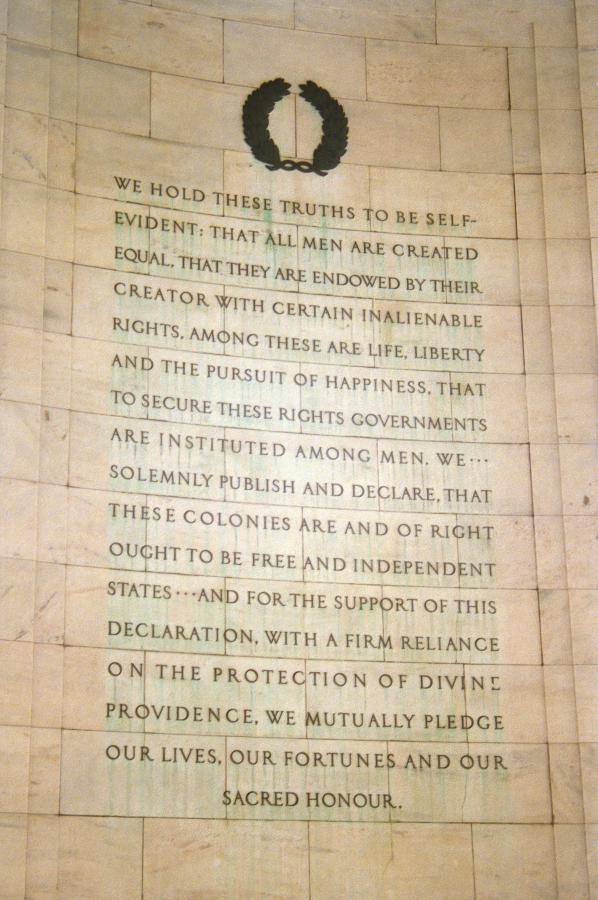
The Declaration of Independence begins with the familiar words: “We hold these truths to be self-evident, that all men are created equal, that they are endowed by their Creator with certain unalienable Rights, that among these are Life, Liberty and the pursuit of Happiness.” While we lament the signatories’ failure to apply these principles consistently (to black slaves, women, Native Americans and others) and may quibble about the scope of being “self-evident,” the Declaration affirms that human nature entails equality and divinely-ordained moral rights. These metaphysical and ethical truths offer direction to government (“to secure these rights, Governments are instituted among Men”) and provide limits to government (“whenever any Form of Government becomes destructive of these ends, it is the Right of the People to alter or to abolish it”). Nearly a century later, the “Declaration of Sentiments, Seneca Falls” (1848) follows much the same reasoning to affirm the equal rights of women: “…this being a self-evident truth growing out of the divinely implanted principles of human nature, any custom or authority adverse to it, whether modern or wearing the hoary sanction of antiquity, is to be regarded as a self-evident falsehood, and at war with mankind.” These truths were sufficiently important so as to lead the Declaration’s signatories to “…mutually pledge to each other our Lives, our Fortunes and our sacred Honor.”
The Declaration’s natural rights tradition is deeply rooted in the Enlightenment, including the thought of 17th century English philosopher John Locke, among others. Locke’s Second Treatise of Government begins by spelling out what the Declaration summarizes. As the “workmanship” of God, humans ultimately belong to God rather than each other, a truth that entails the “law of nature”: “…being all equal and independent, no one ought to harm another in his Life, Health, Liberty, or Possessions.” (§7). Locke argues that humans possess pre-political natural rights and that legitimate governments secure these rights in a manner consistent with human freedom and equality.
James Madison later relies on similar reasoning in his “Memorial and Remonstrance”: “…what is here a right towards men, is a duty towards the Creator. … This duty is precedent, both in order of time and in degree of obligation, to the claims of Civil Society.” Madison clearly sees humans’ obligations to government as secondary to (and relativized by) prior obligations to God. Lest we mistake Madison’s meaning, he decisively rejects a state-established religion on this very basis: The penultimate nature of government requires it to stay out of religion. Madison, like Locke, locates the ends and limits of government in relation to eternal truths.
An important corollary follows: Humans often fail to live up to what they should be, which also orients our political frameworks. Madison acknowledges the fallen human condition in Federalist 51: “But what is government itself, but the greatest of all reflections on human nature? If men were angels, no government would be necessary. If angels were to govern men, neither external nor internal controls on government would be necessary. In framing a government which is to be administered by men over men, the great difficulty lies in this: you must first enable the government to control the governed; and in the next place oblige it to control itself.” We are not only rights-holders but rights-abusers. Moral evil creates great challenges to administering freedom and equality with appropriate safeguards on rulers and the ruled alike.
Affirming orienting truths provides direction and limits to government — what it ought to do and what it must not do. In Aristotle’s classic typology (contrasting monarchy, aristocracy, and polity, with tyranny, oligarchy and democracy), the central distinction between the rightly and wrongly ordered forms of government (whether by one, the few or the many) lies in their telos or end: Do they aim at the common good with a true account of human virtue? We too need to distinguish between good and bad government. Two of the most prominent traditions for such orienting truths in the United States — the natural rights tradition (sketched above) and the Christian natural law tradition (treated briefly below) — offer much worth affirming.
A Government of Laws
As much as I love political theory, I freely admit that we can’t govern on political theory alone. The values of the Declaration of Independence are insufficient for establishing a political order: We also need the Constitution and ordinary legislation. Significantly, the Declaration’s political philosophy presupposes the rule of law as an essential component of good government. I often explain the rule of law as “the rule of rules rather than the rule of rulers.” It involves the governance of fixed, known standards rather than arbitrary power. Sadly, I find declining appreciation for the rule of law in the broader political culture and even among my students. For some, the lure of political consequentialism beckons, where desired outcomes seem to warrant subverting legal boundaries. This pillar of our political tradition merits renewed attention and commitment.
The Declaration of Independence identifies the danger of arbitrary power — in contrast to the rule of law — as the central grievance against Great Britain. Britain’s “long train of abuses and usurpations” covers much more than the oft-cited taxation without representation, cutting off of trade and quartering of troops. Indeed, the majority of abuses cited pertain to the rule of law: withholding legislation, calling for the convening of legislatures at inconvenient places, dissolving representative bodies and preventing the formation of new ones, making the tenure of judges dependent on the king’s will alone, placing military powers over civil leadership, depriving colonists of trial by jury, “…taking away our Charters, abolishing our most valuable Laws, and altering fundamentally the Forms of our Governments.”
In short, the Declaration focuses on disruptions to the normal process for making and executing laws, substituting arbitrary power in its stead. These objections lead to the Declaration’s conclusion that the crown “…evinces a design to reduce them under absolute Despotism…” and “…the establishment of an absolute Tyranny over these States.” The Declaration of Independence relies on the rule of law as essential for securing government’s proper ends.
John Locke explains the centrality of the rule of law in his Second Treatise of Government, explaining that freedom will never be secure under arbitrary power. Indeed, when people serve as judges in their own cases (a sure recipe for self-interested judgments), a pre-political State of Nature persists (§13, 87). To solve this problem, Locke suggests making the law — rather than any person — the highest authority in a government. This facilitates dividing power between making law and executing law — further preventing arbitrary power. (In the classic example, two children agree to split the last piece of pie with one cutting it in half and the other choosing a half, making the results more likely to be fair.)
All this might sound prudent, but is it essential? The answer is an unequivocal yes. This is not because the rule of law never goes wrong — it certainly does. But any alternative cannot escape arbitrary power: the whim or caprice of whoever happens to have power. For those who acknowledge humans’ tendency to self-interested behavior, arbitrary power remains closely associated with oppressing others.
In 1838, early in his political career, Abraham Lincoln spoke to the Young Men’s Lyceum of Springfield, Illinois. His remarks cite what he believes to be the greatest threat to the democratic institutions of the U.S.: the “increasing disregard for law which pervades the country; the growing disposition to substitute the wild and furious passions, in lieu of the sober judgment of Courts; and the worse than savage mobs, for the executive ministers of justice.” Such a threat, if unimpeded, would eventually sever the attachment of the people to their government (what permits voluntary submission, rather than coerced) and to leave the nation (and therefore the natural rights of its citizens) vulnerable to the caprice of the ambitious and ruthless who may seize power. The import Lincoln attributes to the rule of law is worth quoting at length:
“Let every American, every lover of liberty, every well-wisher to his posterity, swear by the blood of the Revolution, never to violate in the least particular, the laws of the country; and never to tolerate their violation by others. As the patriots of seventy-six did to the support of the Declaration of Independence, so to the support of the Constitution and Laws, let every American pledge his life, his property, and his sacred honor; — let every man remember that to violate the law, is to trample on the blood of his father, and to tear the character of his own, and his children’s liberty. Let reverence for the laws…. [B]ecome the political religion of the nation….”
Lincoln continues: “…let me not be understood as saying there are no bad laws — I mean to say no such thing. But I do mean to say, that, although bad laws, if they exist, should be repealed as soon as possible, still while they continue in force, for the sake of example, they should be religiously observed.”
Joining the Two
Do these two commitments, orienting truths and the rule of law, compete with each other — particularly when laws may be unjust? Are we forced to choose between good eternal truths and bad laws? Indeed not. Rightly understood, orienting truths and the rule of law must go together, with orienting truths standing above and informing political law.
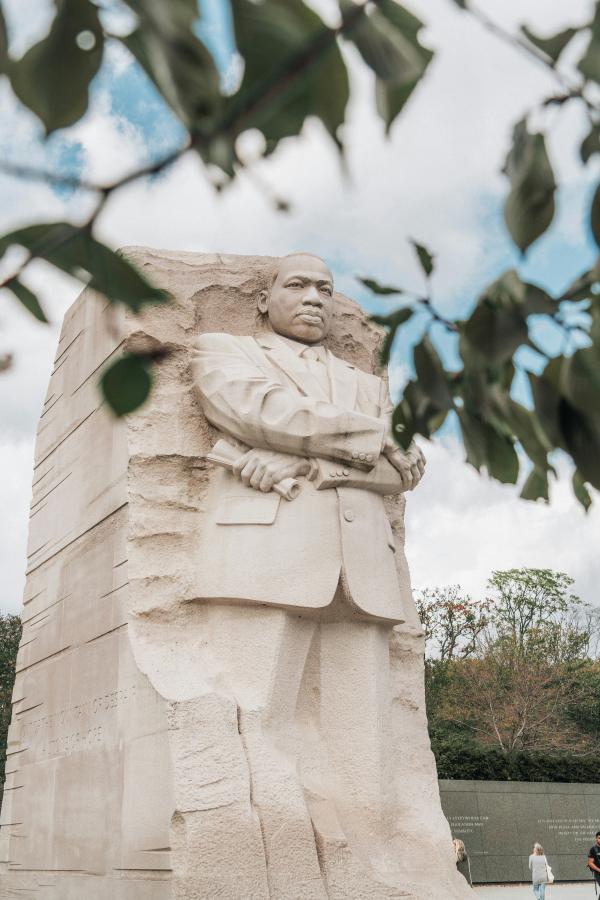
Martin Luther King Jr.’s “Letter from a Birmingham Jail” provides as concise an account of this relationship as any — including his call for civil disobedience. Drawing on the natural law tradition, King writes: “…there are two types of laws: just and unjust.” He continues: “A just law is a man-made code that squares with the moral law or the law of God. An unjust law is a code that is out of harmony with the moral law. To put it in the terms of St. Thomas Aquinas: An unjust law is a human law that is not rooted in eternal law and natural law.” For King, human laws must accord with the orienting truths of the natural law in order to be just. As seen in King’s prophetic rebuke of legal segregation, these orienting truths call unjust human laws to account. The content of King’s orienting truth here is not philosophically obscure: It stands on the personhood of all, regardless of skin color: “Segregation, to use the terminology of the Jewish philosopher Martin Buber, substitutes an ‘I-it’ relationship for an ‘I-thou’ relationship and ends up relegating persons to the status of things,” making it “morally wrong and sinful.”
On this distinction — the law’s relation to the natural and eternal moral law — King bases his case for civil disobedience to unjust laws. While distinct from the obedience of Lincoln’s Lyceum Address, King’s civil disobedience remains far removed from the lawless mob to which Lincoln objects, most obviously in his unbending commitment to non-violence as a means for legal change. Rather than taking the law into his own hands, King seeks correction of the law by drawing public attention to its injustice:
“In no sense do I advocate evading or defying the law…. That would lead to anarchy. One who breaks an unjust law must do so openly, lovingly, and with a willingness to accept the penalty. I submit that an individual who breaks a law that conscience tells him is unjust, and who willingly accepts the penalty of imprisonment in order to arouse the conscience of the community over its injustice, is in reality expressing the highest respect for law.”
On King’s telling, the “real heroes” of Birmingham were those who demonstrated with “sublime courage, their willingness to suffer and their amazing discipline in the midst of great provocation.” These, he maintains, “…were in reality standing up for what is best in the American dream and for the most sacred values in our Judeo-Christian heritage, thereby bringing our nation back to those great wells of democracy which were dug deep by the founding fathers in their formulation of the Constitution and the Declaration of Independence.” In King’s account — as in the Declaration’s — the guidance of orienting truths walks hand in hand with the rule of law.
Conclusion
As we mark the 250th anniversary of the Declaration of Independence, we can benefit from renewing these basic commitments. We need the orienting truths of the natural law and natural rights traditions to help direct, limit and correct our laws. And we need deep regard for the rule of law to avoid the worst dangers of corrupt, arbitrary power.
Might such affirmations risk the hubris of infallibility and wrongfully impose on those who disagree? Such dangers are real. But just because not everyone comes to the same conclusions doesn’t mean some answers aren’t better than others — or that we can avoid staking a claim. As political philosopher Michael Sandel put it in “The Procedural Republic and the Unencumbered Self”: “For all our uncertainties about ultimate questions of political philosophy — of justice and value and the nature of the good life — the one thing we know is that we live some answer all the time.” We can and should cling to what is true and good — as best we can discern it — as the basis for our political commitments and then seek to apply it consistently. Voices such as Frederick Douglass, Elizabeth Cady Stanton and Susan B. Anthony remind us that some of our worst failures as a nation come from inconsistent application, not failures of theory. Drawing upon the natural law and natural rights traditions can actually express a type of humility. While traditions can certainly err and always need to be reformed, such sources of enduring wisdom offer a good place to start.
St. Augustine describes a political commonwealth as a people united by shared “objects of their love,” noting that “the better the objects of this agreement, the better the people” (City of God XIX:24). The orienting truths of the natural law and natural rights traditions and a deep commitment to the rule of law offer worthy shared “objects of love.” Renewed commitment to these would make us a better people, supporting a type of civic virtue in citizens we would do well to see reflected in our government. Increased attention, public commitment and celebration of both would do much good and could serve to heal, even in some small increment, the polarized divisions that currently afflict us.