Transforming Communities Through Public Health
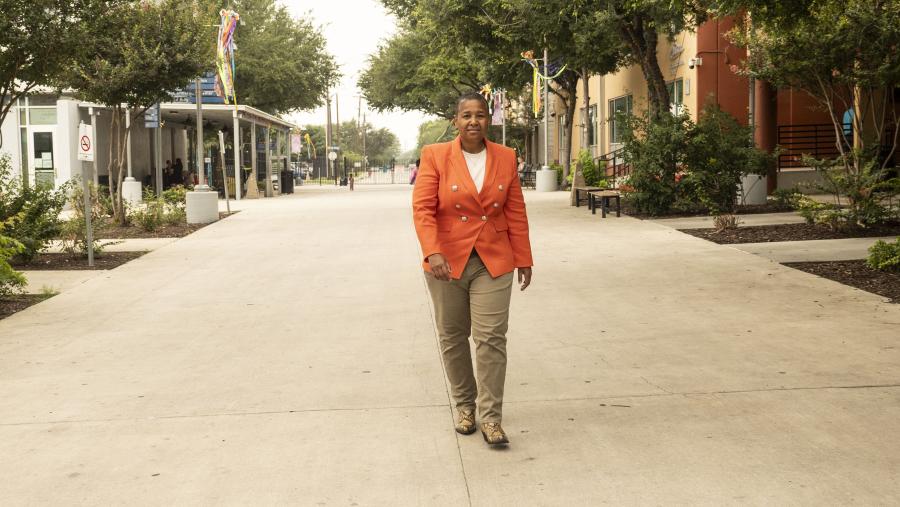
Rhonda Mundhenk ’94 earned a law degree at Northwestern Pritzker School of Law in Chicago and learned it could prepare her for anything — except practicing medicine. Originally interested in international human rights law, she went straight into the healthcare field and discovered an unexpected calling.
In law school, she worked part time in public health with populations suffering from a disparity in care. Her sociology classes at Westmont helped her understand the contributing cultural contexts and consequences for the community, and she wondered how to change the trajectory. “I’ve always had a heart for underdogs and want to come alongside them and use my skills and expertise to help them,” she says.
As director of policy, planning and public affairs for Cook County’s large healthcare organization, Rhonda advocated for public health policies she supported. “It gave me a taste of healthcare administration, and I experienced policy work for the first time,” she says.
Then she joined the staff of a small, 100-bed community hospital in a Chicago neighborhood with great needs, gun violence and disparity. “I grew up in that job and saw the impact healthcare can make in a community,” she says. “I fell in love with population-based healthcare and the challenges of looking at both community and individual needs. Getting out into the field opened new worlds as I saw what people faced.” Rhonda then earned a Master of Public Health at the University of Illinois while working in their Chicago hospital.
Impressed by Lone Star Circle of Care and Clinical Health Network for Transformation — and the much warmer weather of Austin, Texas — she became CEO of the huge organization spanning multiple counties and offering primary care, behavioral treatment and maternity programs. She inherited an institution deeply in debt and restructured it with both private and public funds, making it stronger than ever.
“I had to make it work and move forward as no other organization served its population of 100,000 people,” she says. “I faced my worst fears, got up in the morning, kept going and brought hope to patients.”
The organization’s board covered the cost of her Master of Science in Public Health Transformation at the University of Texas at Austin’s Dell Medical School and McCombs School of Business. “At that point, I’d been in every healthcare situation that interested me,” she says. So she tried something different, becoming chief operating officer for Harbor Health Team Inc., a startup that combined an insurance plan with a delivery system.
Throughout these experiences, she developed skills in collaboration, community building and leading successful teams as she sought equity for diverse, underserved populations.
Today, as president and CEO of Haven for Hope, the largest homeless shelter in San Antonio, she draws on this expertise. “What a privilege to try to solve homelessness, one of the most pressing problems of our time,” she says. “I believe in giving people a chance and a little help — the vast majority find their way out.”
“What a privilege to try to solve homelessness, one of the most pressing problems of our time,” she says. “I believe in giving people a chance and a little help — the vast majority find their way out.”
Haven partners with more than 75 community agencies to accomplish its work, daily serving 1,400 people of all ages, providing emergency shelter, treatment for substance abuse, behavioral health, ID recovery, education, childcare, legal assistance and healthcare. “We spend a lot of energy on training to help people get jobs,” Rhonda says.
In its 15-year history, the shelter has served 52,000 people. “Two-thirds of them only come once,” she says. “This is the real story. The most likely person to be homeless is a child from an economically challenged background. The stereotype focuses on a small percentage: the chronically homeless with substance disorders. More often than not, we can restore people to their family, friends and community.”
Born in Vietnam, Rhonda grew up in Papua New Guinea, where her father worked for the American Bible Society. She attended high school in Malaysia before enrolling at Westmont and earning a degree in social science.