Professor Keeps King’s Dreams Alive

Wendy Eley Jackson, assistant professor of English and film studies at Westmont, recently joined the board of directors for the Martin Luther King Jr. Committee of Santa Barbara. She was instrumental in bringing Leah Weber King, the widow of Dexter Scott King, to serve as keynote speaker for MLKSB’s 19th annual Martin Luther King Jr. Day program Jan. 19 at the Arlington Theatre. The main program begins at 11 a.m., following the annual Unity March up State Street.
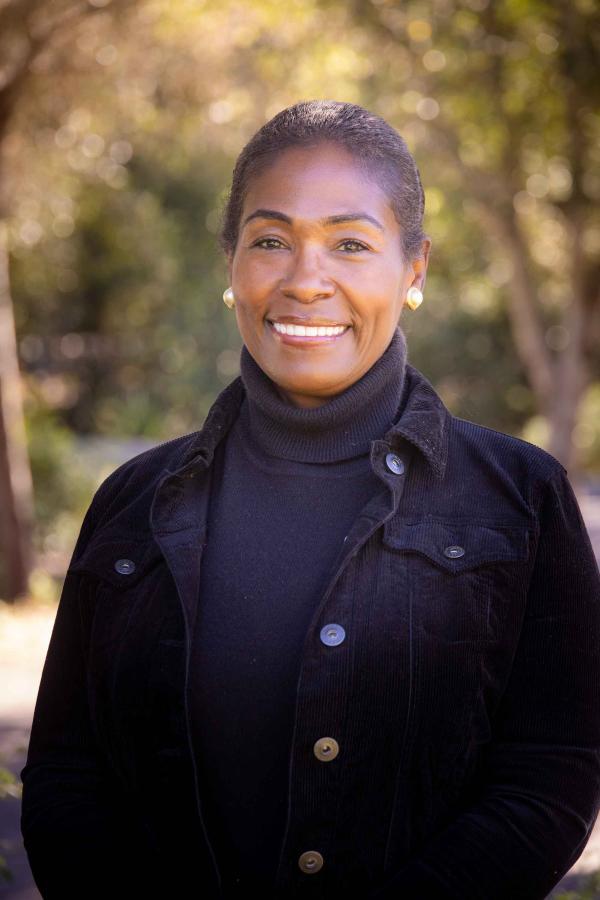
“Dr. King’s life and work remind me that leadership is not merely a position, it’s a responsibility to courageously advance truth, dignity and humanity, especially when doing so is inconvenient or uncomfortable,” Jackson says. “His belief in the moral power of nonviolence and strategic coalition-building continues to inspire my own commitment to civic engagement, community uplift and intergenerational mentorship.
“MLK taught us that justice requires both vision and discipline; that transformation happens not only through speeches and protests, but through systems, institutions and policies that honor the value of every human being. His legacy pushes me to think beyond the present moment and consider what future our actions make possible.”
Jackson, who co-founded the Montecito Student Film Festival at Westmont and serves as its executive producer, has more than 30 years of experience in film and television broadcasting. The founder and executive producer of Auburn Avenue Films, she has worked with major media companies such as SONY Pictures Television and Turner Broadcasting.
She produced the acclaimed feature length documentary “Maynard,” which chronicles the life and legacy of Maynard Jackson, Jr., the first Black mayor of Atlanta and Jackson’s father-in-law. She is developing a film about Ella Fitzgerald, and recently served as executive producer on the documentary “Facing the Falls.” She also co-wrote the feature “30 Days A Black Man.”
“Dr. King’s vision should resonate today as a challenge and a compass,” she says. “The challenge is that his dream remains incomplete — inequalities persist in education, economics, health and citizenship. The compass is that he offered a blueprint for how we move forward: through empathy, courageous truth-telling, structural change, and a radical belief that our destinies are intertwined.
“In a society marked by division and polarization, MLK calls us to choose community over chaos, to build bridges rather than camps, and to insist that freedom is not selective. His vision asks us to remember that equality is not an abstract aspiration — it is a practice, a policy agenda and a moral obligation we must advance every day.”