Making Students Feel Seen, Valued & Loved
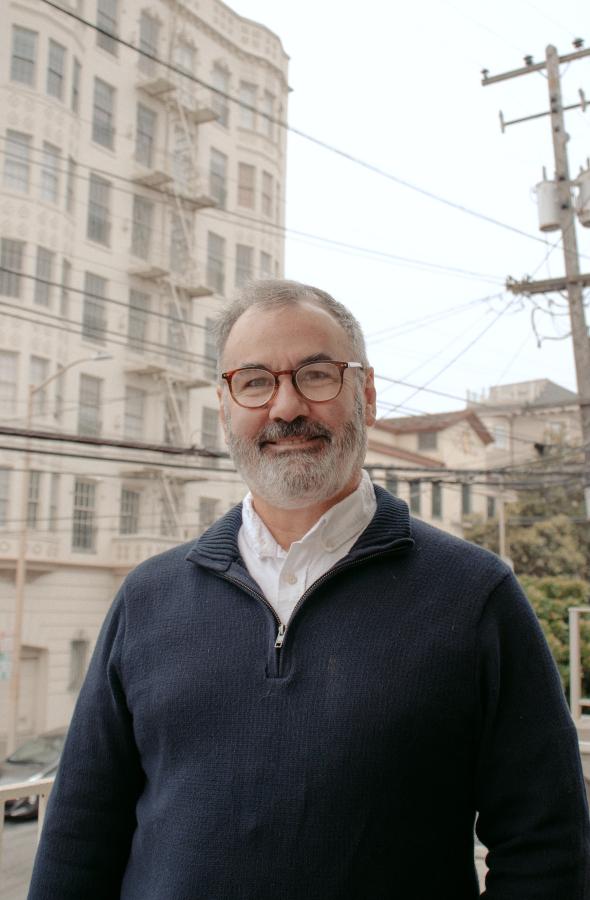
Brad Berky first encountered Westmont’s Urban Program in 1982, when he enrolled in the semester as a Gordon College student. After graduating with a bachelor’s degree in political studies, he earned a Master of Divinity in intercultural studies at Fuller Theological Seminary and completed four years of a doctorate in social ethics at the Graduate Theological Union.
In 1990, he joined the Urban Program faculty, later renamed Westmont in San Francisco. For 36 years, he taught urban studies, mentored students, helped them find meaningful internships in the city and eventually directed the program. He developed relationships with more than 200 businesses, organizations and nonprofi ts to provide a wide range of experiences for students from every major.
Brad has retired from Westmont. “I’m grateful for 36 years of doing work I love, growing close to students,” he says. “The program transformed their lives.”
Brad says students need to develop transferable skills and adaptability, which the liberal arts promote. “We referred to our program as the applied liberal arts,” he says.
He has seen students rediscover their faith. “They found a community in San Francisco and a sense of belonging,” he says. “Internships often give them clarity about their calling and purpose. Being thrown into new situations accelerated their maturity. We were pushing them with one hand and patting them on the back with the other.”
Students participated in important conversations, which arose as they spent time in the city. “Integrating faith and learning only matters if we engage the world as it really is and not as we imagine it,” Brad says. “God still loves the world — it has value. God created everything and is everywhere. We encouraged students to discover where God is working in San Francisco.
“Integrating faith and learning only matters if we engage the world as it really is and not as we imagine it.”
“I love the Christian community here, where the church serves people on the margins, acting as the hands and feet of Jesus. In this post-religious city, students find genuine curiosity about spirituality and encounter people who want to learn about their faith. Being a Christian is now counter-cultural, and many they encounter say they’ve never met a Christian.”
Students and colleagues share high regard for Brad. They write: “Every student who has left the program has become a better scholar, Christian and person because of his love and compassion.” “His dedication to his students and unwavering faith have been a constant source of inspiration.” “Brad has a unique ability to make those around him feel seen, valued and loved. He listens with his whole heart.” “He just radiates God’s love and grace.”
“Brad is the quintessential combination of competence and care. I have seen his compassion and deep sense of presence transform students’ ideas of what is possible for themselves, their vocations and a life of faith. Brad doesn’t talk about service, he serves.”
In the history he has written about the program, Brad honors the visionary professors who established the semester, including Brendan Furnish, Ron Enroth, Robin Wainwright and Jim Keith. He also highlights the contributions of faculty who taught for more than 20 years and played a key role in forming the curriculum: Steve Schultz, Rusty Springer and Karen Andrews.