A 40-Year Career in Economics as Stewardship
When Edd Noell first arrived at Westmont in 1986, he sought more than just a job. He wanted to join a community that considered the study of market forces and financial systems a profound expression of faith. After four decades of service, the professor of economics and business will retire, leaving behind a legacy of academic rigor, global engagement and a deep-seated belief in human flourishing.
Originally from Dallas, Edd earned his MBA from the University of Texas at Austin and his doctorate from Louisiana State University before finding his calling in the Christian liberal arts. Throughout his tenure, he specialized in the history of economic thought, labor market regulation and the intersection of Christianity and economics.
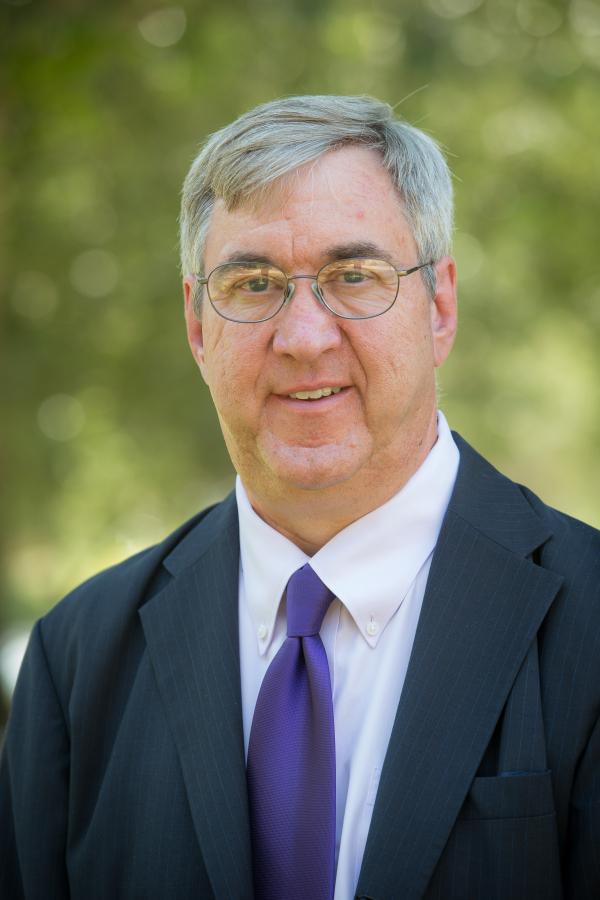
He won awards as Teacher of the Year in 1998 and Faculty Researcher of the Year in 2015. His extensive scholarship, including books such as “Economic Growth: Unleashing the Potential of Human Flourishing” and “Reckoning with Markets: Moral Reflection in Economics” seeks to bridge the gap between older, venerated moral reflections and modern economic systems.
Rick Ifland ’83, a longtime colleague who co-chaired the economics and business department with him, noted the challenges of taking a class from Edd, recalling how his demanding tests famously taught students to pray earnestly, often citing the depths of Psalm 130 before an exam.
“Edd is a master teacher, but he never compromises the demands and the integrity of learning,” Ifland said in a retirement tribute. He shared a sentiment from one of his own sons who studied under Edd, describing him as “the best embodiment of the Christian liberal arts on Westmont’s campus.” Edd frequently modeled his economic way of thinking by integrating literature, art and music into his curriculum. Whether analyzing the transition from feudal systems to European markets accompanied by Renaissance flute pieces or studying Peter Bruegel’s artwork to understand medieval trade, he emphasized that economics exists in a cultural and historical context. He also co-taught The Theology and Economics of Wealth and Poverty with religious studies professor Helen Rhee for more than a decade, fostering a rare dialogue between theologians and economists.
His influence extended far beyond Montecito, becoming a fixture of Westmont’s global programs. Edd participated in more than 15 study-abroad experiences in China, India, South Korea, Japan, Europe and Russia.
“We participate in a globalized economy, and students need to be aware of those dynamics — including competitive challenges, the changing value of the dollar, inflation here and overseas — and to think of themselves as global Christians wherever and with whomever they engage with in the business world,” he says.
Edd served as president of the Association of Christian Economists, and he hosted an ACE conference, “Economics as Faithful Stewardship,” in July 2025 on campus, welcoming scholars from around the world to explore using economic analysis to benefit vulnerable communities.
His work in the local community will continue after he retires, as he serves as an elder for Christ Presbyterian Church. The congregation is building a new, 400-person sanctuary in downtown Santa Barbara.
Edd envisions the possibility of training pastors or seminary students about the meaning of work and wealth through a Christian lens. “I wish to explore with them what it means to be a Christian steward,” he says. “How do we handle our wealth and influence in the Western Church in a way that’s compassionate toward those directly around us as well as the broader church and our global neighbors?”