Alum Earns NSF Fellowship for Underwater Volcano Research
Westmont alumnus Michael Hemmett ’25 has received a prestigious National Science Foundation (NSF) Graduate Research Fellowship to support his pioneering work in marine geology and geophysics.
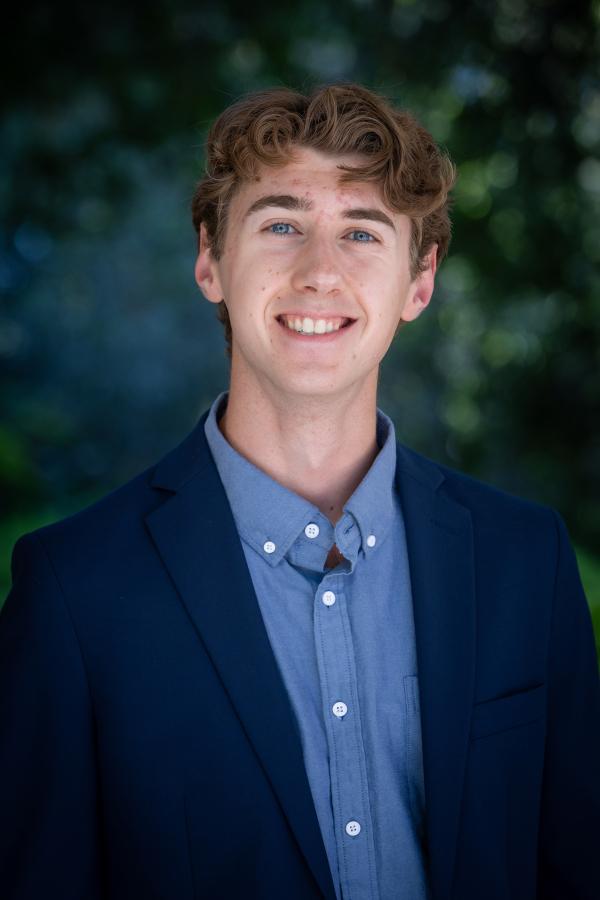
After graduating from Westmont with a degree in physics, he’s completing a doctorate in earth and space sciences at the University of Washington. His research focuses on natural hazards in the Pacific Northwest, a region that shaped his passion for science long before he knew about its geological forces.
“I lived in the shadow of Mount Rainier, and my family took trips to Olympic National Park and the Oregon coast,” he says. “I was deeply aware of both the beauty and potential hazard — big earthquakes, tsunamis, volcanic eruptions — of these natural places.”
While his childhood sparked his curiosity, his time at Westmont harmonized his academic interests with his faith. Reading Blaise Pascal in a first-year Augustinian Scholars course as well as a physics lecture grounded in Colossians 2:3 solidified his direction in life.
“Blaise Pascal was a great mathematician, physicist and theologian,” Hemmett says. “From his work I learned I can love God with my mind through academic pursuits. I became interested in science to study God’s creation, which taught me more about the character, intelligence and creativity of God in Christ, through whom all things were made.”
Initially a political science major, Hemmett developed a passion for investigating God’s creation through mathematics, which drew him to physics. The department named him Outstand Graduate in Physics, noting that he excelled in every aspect of the curriculum and that “his problem-solving is thorough and clever, his laboratory methods are accurate and meticulous, and his integrations of science and faith are thoughtful and sophisticated.”
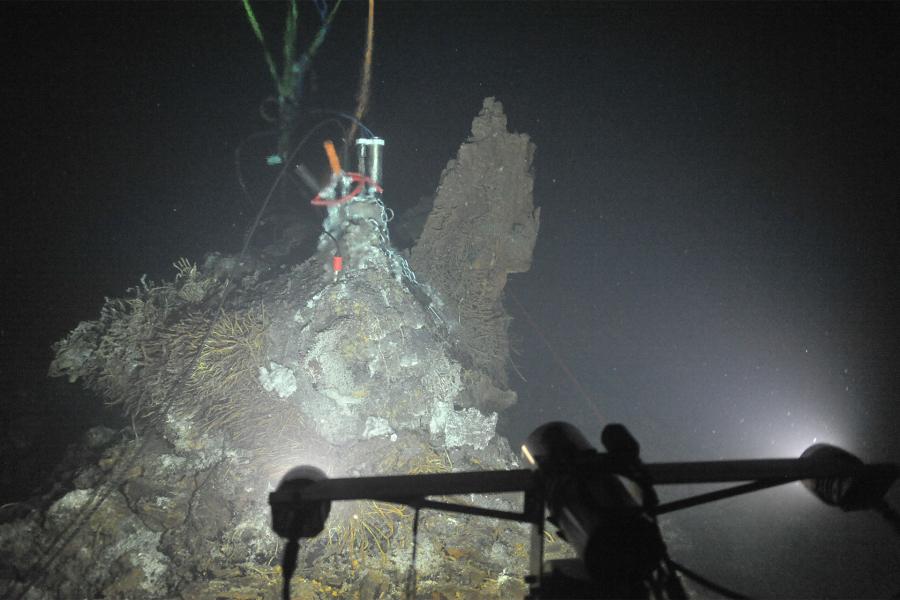
At the University of Washington, Hemmett shifted from the particle physics research he conducted at Westmont to natural hazards, studying Axial Seamount, an active underwater volcano 300 miles off the Oregon coast. Using earthquake data from the Ocean Observatories Initiative, he tracks the volcano’s eruption cycles to better understand volcanic systems worldwide.
His work also extends to the Cascadia Subduction Zone, where the Juan de Fuca plate slides beneath the North American plate, creating the potential for a catastrophic earthquake. He plans to use Distributed Acoustic Sensing, a novel technique that repurposes telecommunications fiber-optic cables as massive earthquake sensors to help map out locked segments of the fault line.
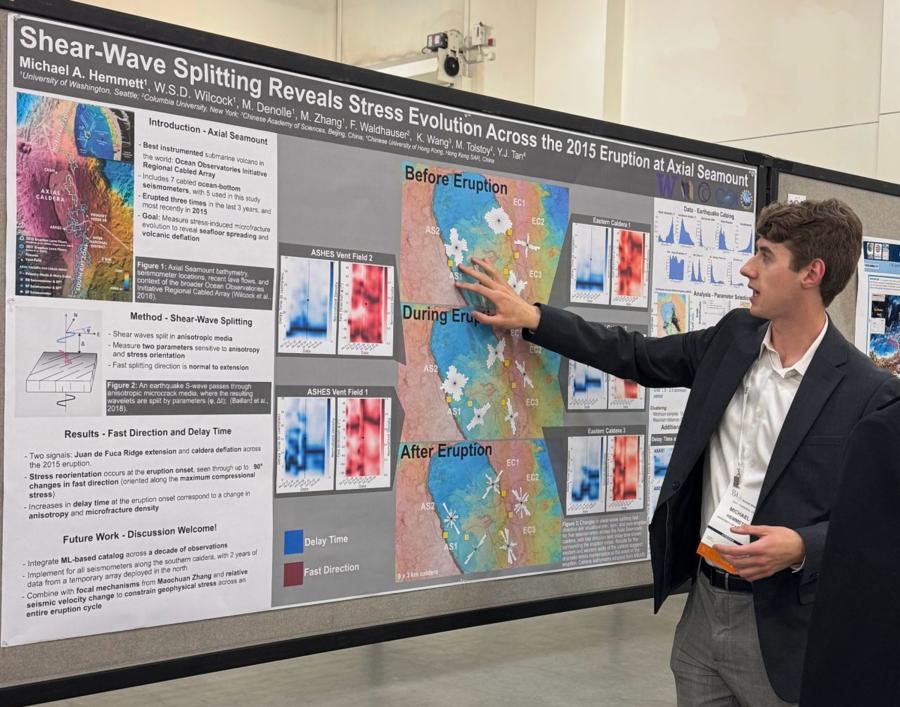
“By understanding where a tremor happens, and more importantly, where it doesn’t, we can better constrain the locked portions of the Cascadia Subduction Zone and better predict how it would rupture in the future,” Hemmett says. He notes that this data will ultimately help engineers improve community resilience.
Only three other graduates from members of the Council for Christian Colleges and Universities received the award this year. He credits Westmont’s holistic, interdisciplinary curriculum, which included studying abroad with the Westmont in Cairo program and co-leading a spiritual formation group, for making him a standout NSF applicant.
“By studying volcanoes and subduction zones, I get to better understand God’s creation while helping to protect the Pacific Northwest community that I call home,” he says. “My Westmont education made so much of this is possible.”