
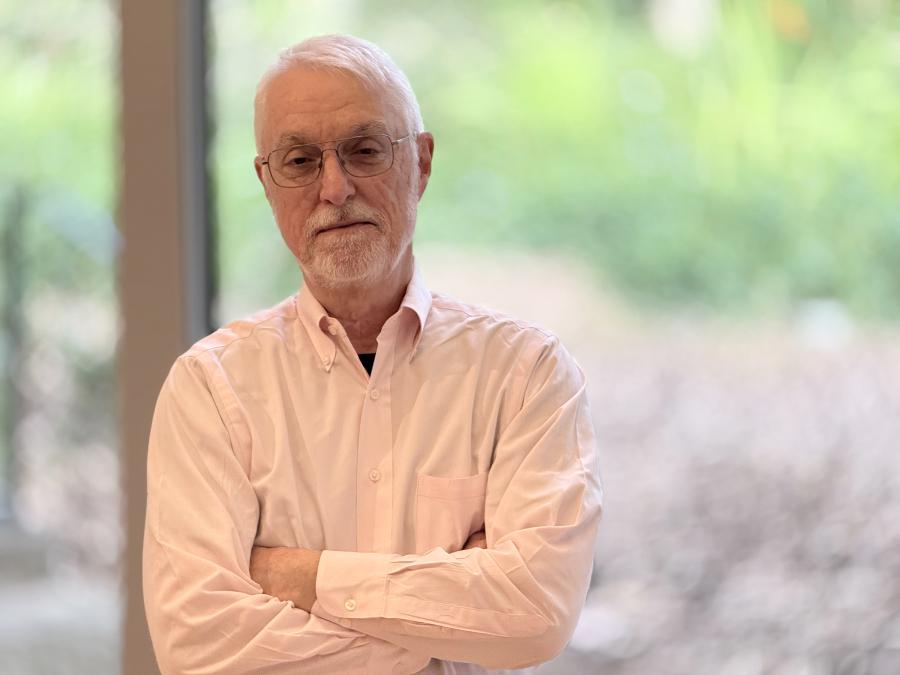
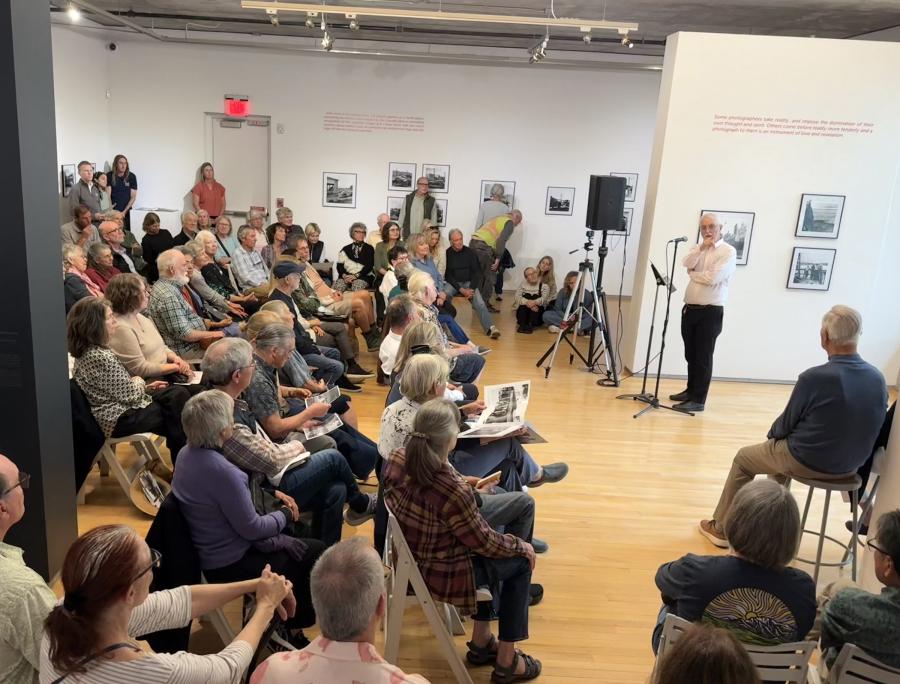
More than 100 people packed into the Westmont Ridley-Tree Museum of Art on Feb. 24 to hear Dennis Doordan, an architectural and design historian, analyzes Los Angeles architecture through photographs Ansel Adams took on assignment there in the 1940s. The talk, “Looking at Ansel Adams Looking at LA,” contrasted Adams’ iconic nature photos with those he captured of Los Angeles' industrial landscape.
“Ansel Adams’ heart is out there,” Doordan said of the gallery near the main entrance, containing the classic images associated with Adams, including “Yosemite Valley, “Monolith, the Face of Half Dome” and “Moonrise, Hernandez, New Mexico.” “His wallet is in this room.”
Doordan highlighted Adams' discomfort with modernity and programmatic architecture, such as the Brown Derby, that he photographed while on assignment for Forbes magazine.
While not in the current exhibition, Doordan passed around Adams' wartime photos of Manzanar internment camp, taken in 1944. He compared them to Adams’ timeless nature images, emphasizing the troubling beauty and historical significance of his work.
“The difference is that Manzanar was not a timeless human settlement — it was a camp — and the huts are arranged according to the geometric order,” he said. “That is an alien intrusion on the land. So, I want to suggest that the photos don't quite have the same quality of beauty. Or if they have a beauty, which the best of Adams's work does it is an unsettling beauty. They are unsettling photographs first, because building those camps was a shameful chapter in American history, and unsettling because we are building camps again now.”
Doordan, professor emeritus of the University of Notre Dame School of Architecture, graduated from Stanford University, earned a doctorate in the history of architecture from Columbia University and serves as commissioner for Santa Barbara’s Historic Landmarks Commission.
“This is not a classroom, it's a college museum gallery,” he said. “This is a learning space, and this exhibition is a terrific demonstration of what a college gallery can contribute to the educational mission of a college like Westmont. Issues are raised and questions are asked in a setting that supports discourse.”
Doordan said the exhibition is also perfect place to talk about one of the major concerns of college students everywhere: how to pay the rent and develop their talents; and how to make a living and stay true to their ideals. “What can Ansel Adams teach us about answers to these questions?” he asked. “And for all of us who live in and love California, what is the fate of the great American spaces Ansel Adams captured so eloquently and made us see so deeply?”
“Beyond the Wilderness: Ansel Adams in 1940s Los Angeles” is on view at the museum through March 28.