Students Bring Cutting-Edge Engineering Research to Conference

Two Westmont engineering students presented their research findings at the American Society of Mechanical Engineering (ASME) Annual Meeting in November at Memphis.
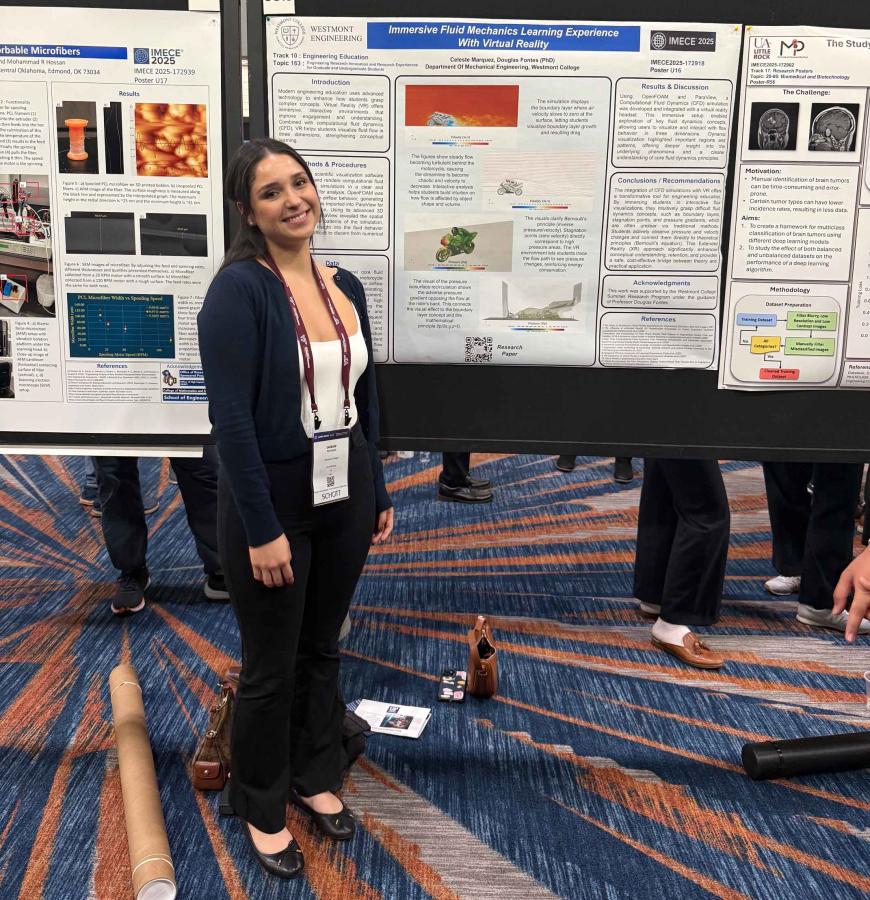
Senior Celeste Marquez of Goleta and junior Peter Velgersdyk of Minnetonka, Minnesota, had rare opportunities as undergraduates to work on peer-reviewed papers.
“This is quite an accomplishment for our students,” says Dan Jensen, director of engineering. “Westmont’s undergraduate engineering students have had 37 co-authorships on peer-reviewed publications in just the last four years.”
Marquez’s research focuses on bridging the gap between advanced fluid mechanics analysis and how fluid dynamics is usually taught to engineering students.
“The goal was to make learning more interactive and immersive, helping students better understand concepts that are hard to visualize with traditional teaching methods,” she says. “I created a computational fluid dynamics simulation that highlights key ideas and allows students to explore them in greater depth.”
The simulation was then adapted for use in a virtual reality headset using OpenFOAM, ParaView and a Valve Index to support future educational games and activities.
Marquez says she benefitted greatly from being exposed to presentations of graduate research that offered a glimpse of her future as an engineer. “Sharing my research was as valuable and exciting as hearing about everyone else’s innovative research approaches and applications,” she says.
Velgersdyk’s research explores how different AI tools can support the four-step design innovation process: discover, define, develop and deliver. “It evaluates systems like ChatGPT, Miro Assist, CADscribe and Stable Diffusion to understand where AI genuinely strengthens creative thinking and where it introduces limitations,” he says. “The main goal is to understand how these tools fit into the design process and how engineers can use them thoughtfully and effectively to create new designs.”
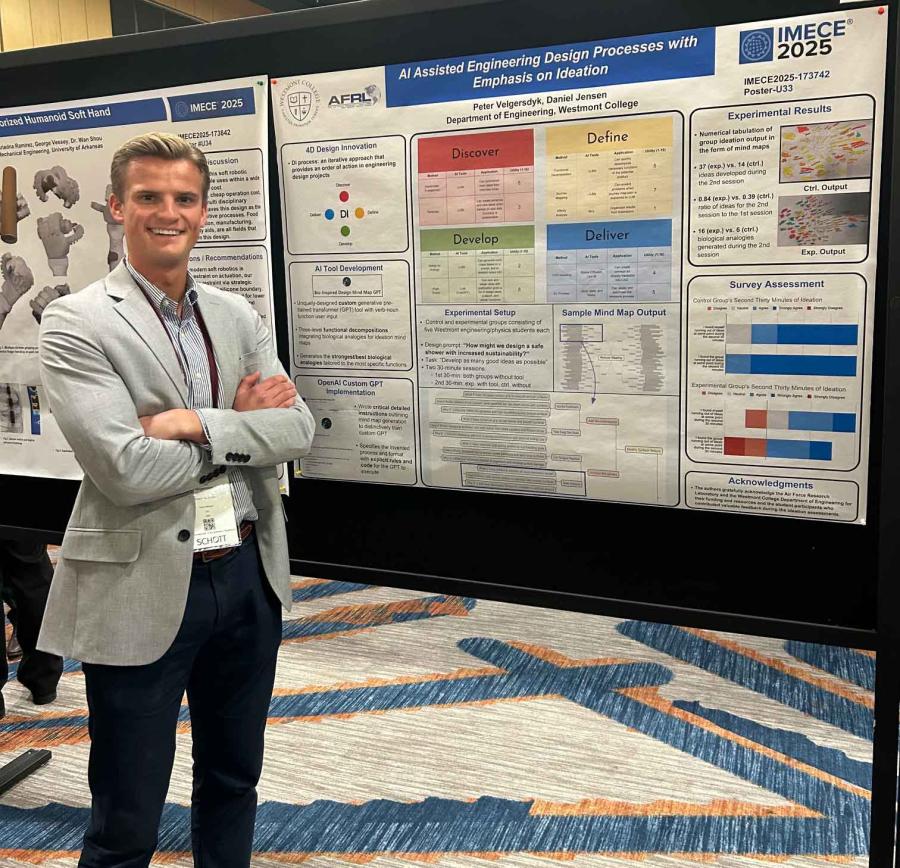
He built a custom AI tool that uses OpenAI’s GPT technology to come up with design ideas inspired by nature. After giving the tool a simple description of what a product needs to do (its basic function), the AI suggests creative, nature-based ways that function could be achieved. “It quickly produces a clean, visual mind map,” he says. “When we compared it to standard ideation techniques, the group using the tool generated more ideas and pushed their thinking further, which was exciting to see.”
Velgersdyk says the conference was energizing, pushing him to communicate more clearly. “It was encouraging to see genuine interest in our research on AI in design,” he says. “I’m grateful for how much this experience strengthened both my technical abilities and my confidence in communicating and working with others.”