2026 Spring Research Symposium 30 Years of Discovery: Celebrating Student Research

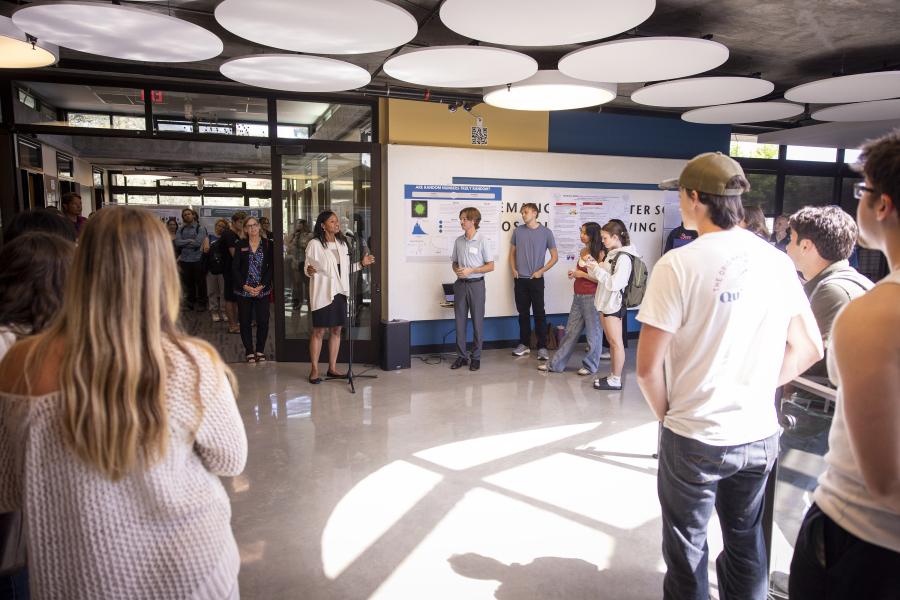
More than 40 students presented posters and explained their fascinating research projects at the 30th annual student research symposium April 16 in Winter Hall.
One of the hallmarks of Westmont’s academic program is the opportunity for undergraduate students to work directly with faculty on research and scholarly projects.
“Research matters because people matter,” said Provost Kim Denu at the celebration. “It’s important to bring scientific investigation and methods to troubleshoot and solve real life problems. I love the fact that you’re probing and asking important questions. Whether you’re doing qualitative or quantitative research, experiments, or you’re testing a hypothesis, it all matters, and it’s important for the greater social good.”
The presenting students have been conducting research with their professors for the past year from the divisions of the humanities, social sciences, and the natural and behavioral sciences.
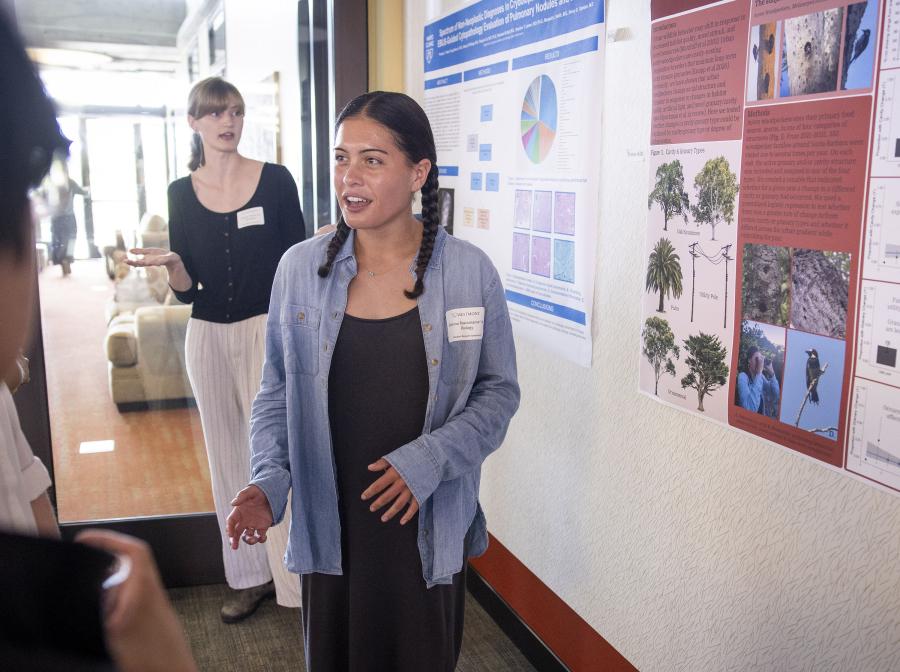
The 30 research projects included a wide range of topics, including woodpeckers’ use of utility poles, palm trees, ornamental trees or native trees in “Home is where the acorns are: A multi-year analysis of shifts in acorn woodpecker cavity and granary use across an urban gradient” by Emma Bustamante ‘26. “Families were most likely to change both to and from utility poles,” she said. “It’s possible this was due to wood durability, woodpecker preference, and ease of drilling.”
Lucy Mangum ‘27 and Asher Trammel ‘27 researched how faith increases patience when contemplating death in an experiment “Afterlife in Forelife: How Religion Modifies Economic Responses to Mortality.” Carter et al (2012) found that religious individuals were more willing to wait for a larger reward, exhibiting reduced delayed discounting. “They theorized it’s because when people think about their death, they’re thinking about bucket list items: What do I have to do before I die?” Trammel says. “Our findings clarify the study showing that in religious people, this happens even more than less religious people.”
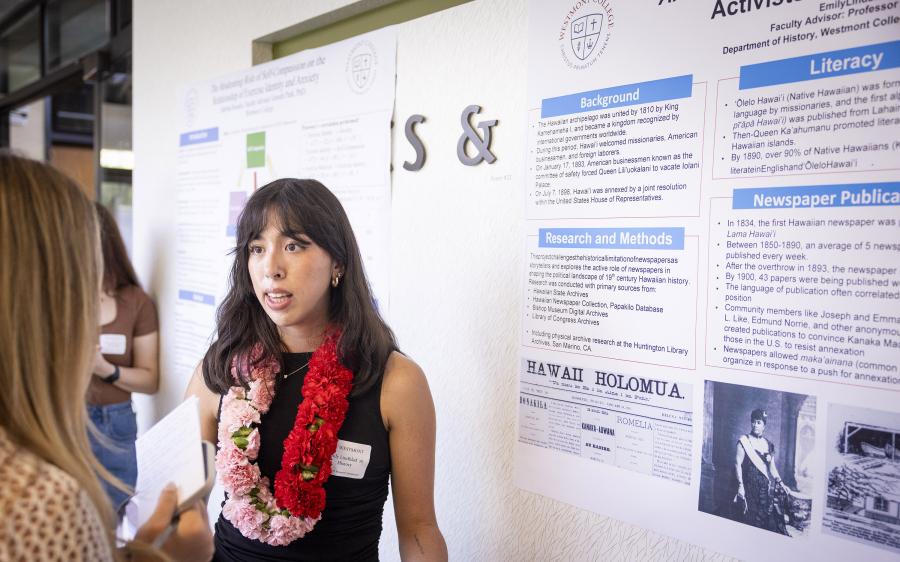
Emily Lindblad ‘26, working with history professor Alastair Su, presented Ali”Aloha ‘Āina: Newspapers as Political Activists in 1890s Hawaii.” She used an archival collection of newspapers in native Hawaiian to evaluate the extent of indigenous agency and political action in 1890s Hawaii. “I was surprised at the amount of newspapers for a country that had only recently adopted a written language,” she says. “The true imbalance in news was the content the people in the U.S. were reading.”
One chemistry project, “Enhanced Fluorescence of Naphthalene and Biphenyl Overlayers,” included student researchers Blake Bush ‘29, Jena Fujitaki ‘29, Maxwell Fuller ‘28, Vanessa Kragelund ‘29, Alan Lopez ‘26, Brandon Moses ‘27 and Caleb Tobey ‘28 with Allan Nishimura, emeritus distinguished professor of chemistry.