21st Annual Westmont President's Breakfast Pulitzer Prize Winner Examines Antisemitism, Foreign Policy

World-renowned journalist and Pulitzer Prize-winning New York Times columnist Bret Stephens emphasized the importance of global stability for economic prosperity, criticized the decline in civics education and stressed the irreplaceable value of a liberal arts education at the 21st annual Westmont President’s Breakfast on Feb. 27.
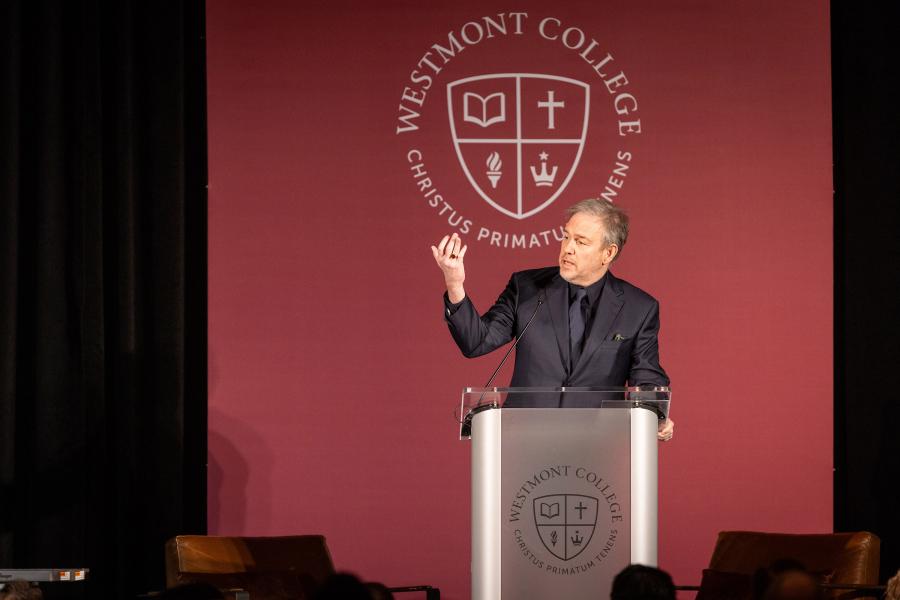
Hours before the U.S. and Israeli attack on Iran began, Stephens commented on the imminence of war. With the Iranian regime at a historically weak position, he thought it worth the risk — and he identified it as a risk — to “kick the regime in the legs.”
A descendent of Jewish immigrants on both side of his family, Stephens spoke about his great-grandfather born in what is now Vilna, Lithuania. Moving to Russia, away from his rabbinic roots, he became a successful publisher but was arrested twice: the first time by the Czarist regime and later by the KGB, the former Russian secret police and intelligence agency. Then he vanished. His widow moved to Latvia and later Berlin, where his grandmother and her two sisters grew up.
“In 1933, Adolph Hitler came to power, and my great-grandmother, who had a well-developed instinct for danger, had the very good sense, unlike many other Jews in Germany at the time, to get out as soon as she could,” he said. Eventually, she settled in northern Italy, but the Nazis later took over the region. “Thanks to a family of righteous Gentiles, my great-grandmother and her three daughters acquired fake names and survived the war.”

Stephens wears a signet ring from that benevolent family, which his father gave to him. In 1950, Stephens’ mother and grandmother arrived in the U.S. with $7 between them, courtesy of President Harry Truman’s Displaced Persons Act.
He used his first speaking opportunity at a Christian college event to share his perspective as a Jew, describing a recurring nightmare cycle where Jews face persecution in various communities and manage to prosper before being targeted by a powerful regime. The American Jewish community has flourished, he said, due to the American spirit and the country’s conception of itself as a New Jerusalem. “Individual and group success was not met with envy as it was elsewhere in the world,” he said. “It was met with admiration. To do well in the United States, to achieve the American dream, was a reason for people of all faiths to admire you, no matter where you came from, no matter what faith you practiced.”
But something changed in the last 25 years. “The word privilege has increasingly replaced what we used to call success, which was earned and therefore admired,” Stephens said. “With privilege, the presumption is it’s unearned and therefore despised and envied. When we redefine the concept of success in this country and think that what some have, they don't deserve, we’ve put people who have succeeded in life into jeopardy. And that tends to fall on groups that have economic power or success, but not political power: minorities, including the Jews.”
In a time rife with conspiracy theories in the United States, Stephens said that when people will believe anything about anything, they’ll eventually believe anything about Jews. “Antisemitism isn't just bigotry, a prejudice, it’s also a conspiracy theory,” he said.
The Hamas attack on Israel on Oct. 7, 2023, has made it more difficult and challenging to be Jewish, he said. “Something has gone deeply wrong in the fabric of much of American life that is suddenly making the United States less hospitable to its Jewish neighbors and fellow citizens, and it should be worrying to every single person in this room,” he said. “Antisemitism is always the symptom of a deeper rot, a deeper cancer in the rest of society.”
During a question-and-answer session with President Gayle D. Beebe, Stephens noted the United States now spends less on defense as a percentage of GDP than in the past. “Having a more secure world, ensuring the strength and resilience of our allies, having robust trading partners in Korea, Japan, Israel, Europe and elsewhere around the world is good for us,” he said. “Global disorder tends to lead to economic disorder here.”
He said the nation’s biggest mistake in the last 40 years was dropping civics education. “It’s terrifying for American life that the country is raising a generation of people who have no idea what the United States is all about except the vague notion that it’s imperialistic and bad,” he said. “No sense that this country has been a greater benefactor for the world bar none.”
When asked about U.S. involvement in the war in Ukraine, Stephens argued that Ukraine is fighting for the freedom of the entire western world. “Russia will not stop with Ukraine,” he said. “If they’re victorious there, their appetite will then move to Moldova and move to Latvia or Estonia, or the more vulnerable NATO states, and in doing so, it’s going to embolden the Chinese as well.”
Stephens quoted President Bill Clinton’s statement that there’s nothing wrong with America that can’t be fixed by what’s right in America, noting that historically, what’s right with us has overcome what’s wrong. “I’m confident that will happen again,” he said.
Noting that while AI is massively disruptive and will replace jobs that require effort and skill, he thinks it won’t replicate human excellence or the unique human experience.
“AI won’t replace human beings trained in the liberal arts, following, creating and inventing a unique human experience,” he said. “AI is made in the image of man, but man is made in the image of God. Good, thoughtful, serious colleges like Westmont, which train 1,200 students to be mature, unique spiritual beings developing capacities for genuine independent thought and ethical action, are irreplaceable. That’s what you guys are doing, and that’s why you should be optimistic.”
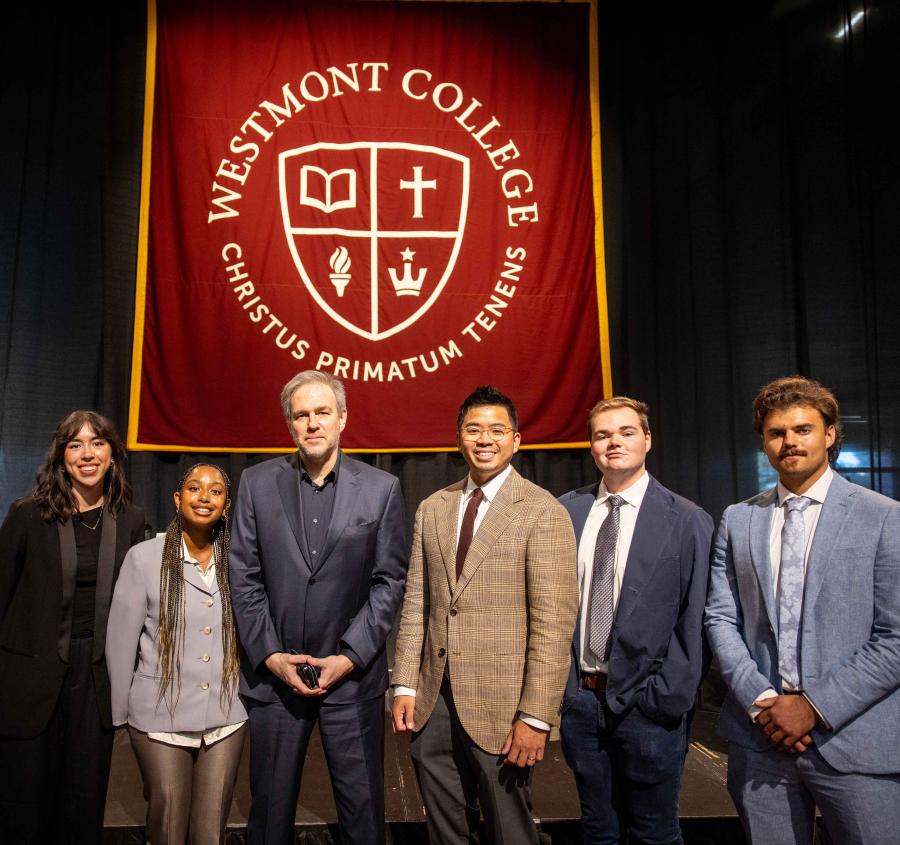
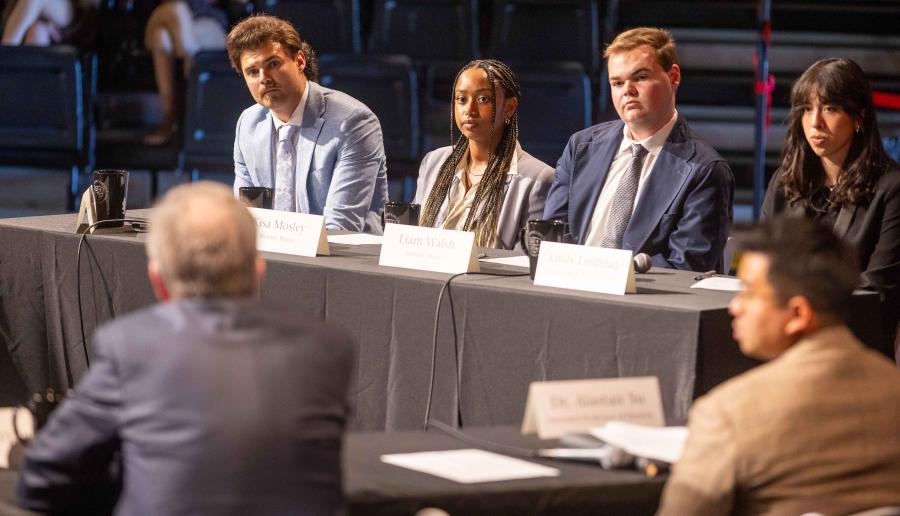
On campus at convocation, Stephens answered questions from professor Alastair Su and four history majors: Lucas De Dora, Kisa Mosley, Liam Walsh and Emily Lindblad. “This is an incredible privilege to be on what must be the most beautiful campus in America,” Stephens said.